Time blocking
Give every hour a job: plan the day in blocks and defend them.
Stop putting it off: one task, 25 focused minutes, a short break, then repeat.
9 min read · Updated Oct 23, 2026
The Pomodoro Technique is the simplest focus system that actually works: pick one task, work on it for 25 minutes, then take a 5-minute break. After four rounds, take a longer break of 20 to 30 minutes. That is the whole method. Its power is not the numbers, it is the deal you make with yourself: for the next 25 minutes there is exactly one thing.
This guide covers where the method comes from, how to run it, how long each round should really be, what to do in the breaks and the mistakes that quietly break it. If you would rather start first and read later, open the Pomodoro timer and come back between rounds.
Francesco Cirillo came up with the method in the late 1980s as a university student who could not get through his reading. He grabbed a kitchen timer shaped like a tomato, set it for a short stretch and promised himself to study until it rang. "Pomodoro" is Italian for tomato, and each focused round has been called a pomodoro ever since.
The original idea was never about squeezing out more hours. It was about making time visible: a round you can see ending is far easier to start than an afternoon with no edges.
1Choose one task
Not three, not "catch up on email". One task with a visible finish: "draft the proposal intro", "solve exercises 1 to 5".
2Set 25 minutes
Start the timer and work until it rings. If something else pops up, write it down and return. No detours.
3Take a real 5-minute break
Stand up, look away from the screen, drink water. A break at your desk scrolling is not a break.
4Repeat four times
Four rounds make one set. Mark each finished round: the tally is what turns effort into momentum.
5Rest 20 to 30 minutes
A full reset before the next set. This is where the technique pays for itself across a whole day.
Twenty-five minutes is the classic length and the best place to start, but it is a default, not a law. Use the table as a starting point and adjust after a few days of honest rounds.
| Focus | Break | Good for |
|---|---|---|
| 15 min | 3 to 5 min | Days when starting is the hard part, or tasks you dread |
| 25 min | 5 min | The classic: email, admin, study sessions, most work |
| 45 min | 10 min | Writing, design and coding once you are warmed up |
| 50 min | 10 min | Long study blocks and exam preparation |
| 90 min | 20 min | Deep creative work, one or two blocks a day at most |
A simple rule: if you often stop before the timer rings, shorten the round. If you regularly feel interrupted right when you get going, lengthen it by 5 or 10 minutes. Keep the break at roughly a fifth of the focus time.
BluePomodoro turns focus and break lengths into four moods you pick in one tap from the Pomodoro Cycle picker. A mood sets both numbers at once and locks them; touch any minute and the picker becomes Custom, so the four presets are always there when you come back. The moods are not levels to climb. They are a way to match the round to the day you are having.
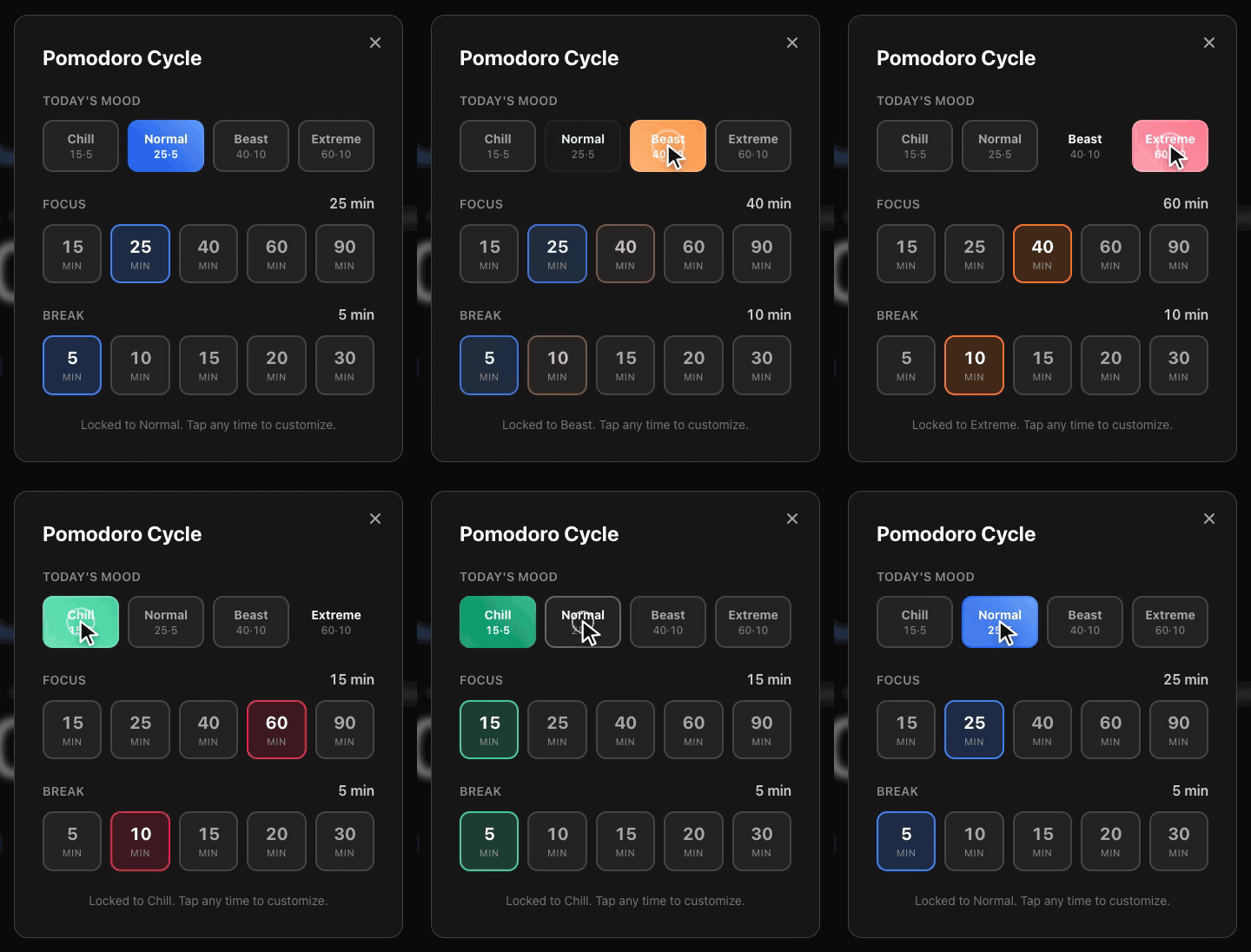
Start on Normal for a week and watch how your rounds end. If you regularly finish with energy left, move up to Beast. If you keep abandoning rounds or dreading them, step down to Chill: a short round you finish beats a long one you abandon.
You can also change mood during the day. Many people put Extreme or Beast in the morning, when they are sharpest, Normal after lunch and Chill for the last stretch. Moods are free to switch, so treat them as a dial, not a commitment.
Interruptions come in two kinds. Internal ones are your own thoughts: "I should reply to Ana", "did I pay that bill?". Write them on a list the moment they appear and go straight back to the task. The list empties your head without breaking the round.
External ones come from other people. If it can wait, say so and agree on a time to get back to them: most things can wait 20 minutes. If it truly cannot, stop the round, deal with it, and start a fresh round afterwards instead of pretending the broken one counts.
You do not rise to the level of your motivation. You fall to the level of your next 25 minutes.
For studying, rounds keep revision active instead of passive: one round to read, one to summarise, one to test yourself. Plan the session by rounds ("four rounds on chapter 3") rather than by hours.
At work, the technique shines on tasks you keep postponing and on days full of small requests. Batch the small things into one or two rounds and protect the rest of the day for the work that matters.
Many people with ADHD find a short, visible countdown makes starting easier, and some prefer rounds of 10 to 15 minutes with a sound in the background. It is a tool to try, not a treatment: keep what helps and drop what does not.
It is long enough to make real progress and short enough that starting feels easy. Cirillo settled on it through trial and error, and it remains a good default. Change it once you know how your focus behaves.
Most people get between 6 and 12 real rounds on a full working day, since meetings and messages take the rest. Start by aiming for four, one full set, and build from there.
Use the remaining minutes to review what you just did: check it, polish it or plan the next step. Then take your break as usual.
Yes. The method is about fixed, protected rounds, not about the number 25. Pick a length from the table above and keep it for a few days before changing again.
Many people with ADHD find short rounds and a visible countdown helpful for getting started. It is not a medical treatment, so treat it as an experiment and adapt the lengths to what works for you.
Yes. BluePomodoro runs in your browser on desktop and mobile, is free to start and needs no sign-up for your first session.
Give every hour a job: plan the day in blocks and defend them.
Do the hardest task first and the rest of the day feels easy.
Timers, tasks and teams in one calm place. Free to start, no card required.
Open BluePomodoro free